


Running a restaurant today means balancing customer experiences, staff efficiency, and tight margins. Choosing the right point-of-sale (POS) system is one of the most impactful decisions you can make as a restaurant owner. Toast and Square are two of the most popular options.
In my Toast vs Square comparison, both platforms stand out for providing dependable payment processing and business management tools. But their strengths align with different types of food businesses.
Here’s how they stack up at a glance:
- Toast: Best for full-service restaurants, bars, and multi-location operators who need advanced tools like table management, kitchen displays, and built-for-restaurant hardware.
- Square for Restaurants: Best for cafes, food trucks, and small restaurants that value low startup costs, quick setup, and straightforward POS functions without long-term contracts.
This guide compares Toast and Square across pricing, features, hardware, support, and overall restaurant fit, so you can decide which system best serves your operation.
- Toast vs Square quick comparison
- Toast vs Square pricing and fees
- Toast vs Square hardware
- Square vs Toast: A true cost breakdown of monthly fees
- How are Square for Restaurants and Toast different?
- Advantages of Toast
- Disadvantages of Toast
- Advantages of Square for Restaurants
- Disadvantages of Square for Restaurants
- Frequently asked questions (FAQs)
- Last bite
Toast vs Square quick comparison
| Toast | Square for Restaurants | |
|---|---|---|
| Our rating | 4.64 out of 5 | 3.83 out of 5 |
| Best for | Full-service restaurants, bars, multi-location operations | Cafes, food trucks, small restaurants |
| Pricing | $0 for a Starter Kit; paid plans start at $69/month/location. Most require a 2-year contract. | $0 for Square Free; paid plans start at $49/month/location. Month-to-month, no contract. |
| Payment processing fees | 2.4%–2.6% + 10–15 cents (flat-rate processing) | Starts at 2.49% + 15 cents for Standard; starts at 3.09% + 15 cents for Pay-as-you-Go plans |
| Hardware | Restaurant-grade handhelds, kitchen displays, and spill-proof terminals. Built to handle busy kitchens. | iPads, Square Register, countertop and handheld readers. More affordable, but less durable. |
| Restaurant POS features | Table & menu management, coursing, inventory, payroll, loyalty, and advanced reporting. | Core POS, menus, basic reporting. Add-ons for payroll, inventory, and loyalty. |
| Support | 24/7 phone, email, in-app support. | Phone/chat during business hours; large self-help library. |
| Visit Toast | Visit Square for Restaurants |
Toast vs Square pricing and fees
Monthly software fees
Both Toast and Square offer free starter-level POS options, but they take different approaches. Toast provides a Starter Kit with no upfront monthly fees, using a pay-as-you-go model that charges per transaction and limits users to one location and two terminals.
Square’s Free POS plan, on the other hand, includes software for unlimited terminals at no cost, giving it a more flexible advantage for operators who want room to scale without additional restrictions.
When it comes to paid tiers, Square remains the more affordable option. Its Square Plus plan begins at $49 per month per location, while Toast’s standard Point of Sale subscription starts at $69 per month per terminal, making it considerably more expensive as businesses add devices across multiple dining areas.
On top of that, many of Toast’s most valuable tools, such as loyalty programs, online ordering, and payroll, require additional fees. For restaurants looking to expand, this structure often drives Toast’s actual monthly costs far above Square’s.
| Toast | Square for Restaurants |
|---|---|
| • Starter Kit: $0/month (1 location, up to 2 terminals) • Point of Sale: Starting at $69/month • Build Your Own: Custom pricing • Bundle POS + Payroll: Starting at $69/month + $9 per employee/month • Free trial: None | • Square Free: $0/month per location • Square Plus: $49/month per location • Square Premium: $149/month per location • Free trial: 30 days for paid subscriptions |
Payment processing fees
Square uses simple flat-rate pricing, and this predictable structure makes it easy for small businesses to manage cash flow. Another advantage is Square Banking, which offers same-day deposits, an important benefit for operators running on tight margins.
On the other hand, Toast’s payment processing rates vary depending on the plan. The $0-per-month Starter plan carries the highest fees, while restaurants on paid plans or custom contracts may be able to negotiate better terms.
One thing to note, though, is that Toast has a key advantage for bars and taverns because it supports pre-authorized bar tabs, which Square does not. Deposits usually arrive the next day if closed before 9:30 p.m. ET, though later batches can take up to two business days. Another difference to note is that Square supports PayPal for online purchases, while Toast does not.
Overall, Square wins on transparency and cost, especially for operators who need quick access to funds and simple processing with no approval hurdles. Toast is better suited for high-volume restaurants or bars that need bar tab pre-authorization and can balance out higher fees with negotiated contracts.
| Toast | Square for Restaurants |
|---|---|
| • Pay-as-you-Go: Starts at 3.09% + 15 cents • Pay-as-you-Go Core: Starts at 3.39% + 15 cents • Pay-as-you-Go Growth: Starts at 3.69% + 15 cents • Standard plan: Starts at 2.49% + 15 cents | • Card-present transactions: 2.4%–2.6% + 10–15 cents • Online payments: 2.9%–3.3% + 30 cents |
Toast vs Square hardware
Square offers more flexibility and affordability in hardware since it can run on iPads and provides its own line of devices, including a free magstripe reader. For larger setups, hardware bundles are available with financing options, making it easier for businesses to scale without a heavy upfront investment.
Toast takes a different approach with proprietary, restaurant-grade hardware designed for demanding environments. Its lineup includes restaurant technology, like spill-resistant touch terminals, rugged handhelds, and high-performing kitchen display systems (KDS) built to handle grease, spills, and long service hours.
While this durability comes at a higher cost, especially for handheld terminals, Toast’s hardware is well-suited for high-volume kitchens where resilience is critical.
| Toast | Square | |
|---|---|---|
| Handheld device | 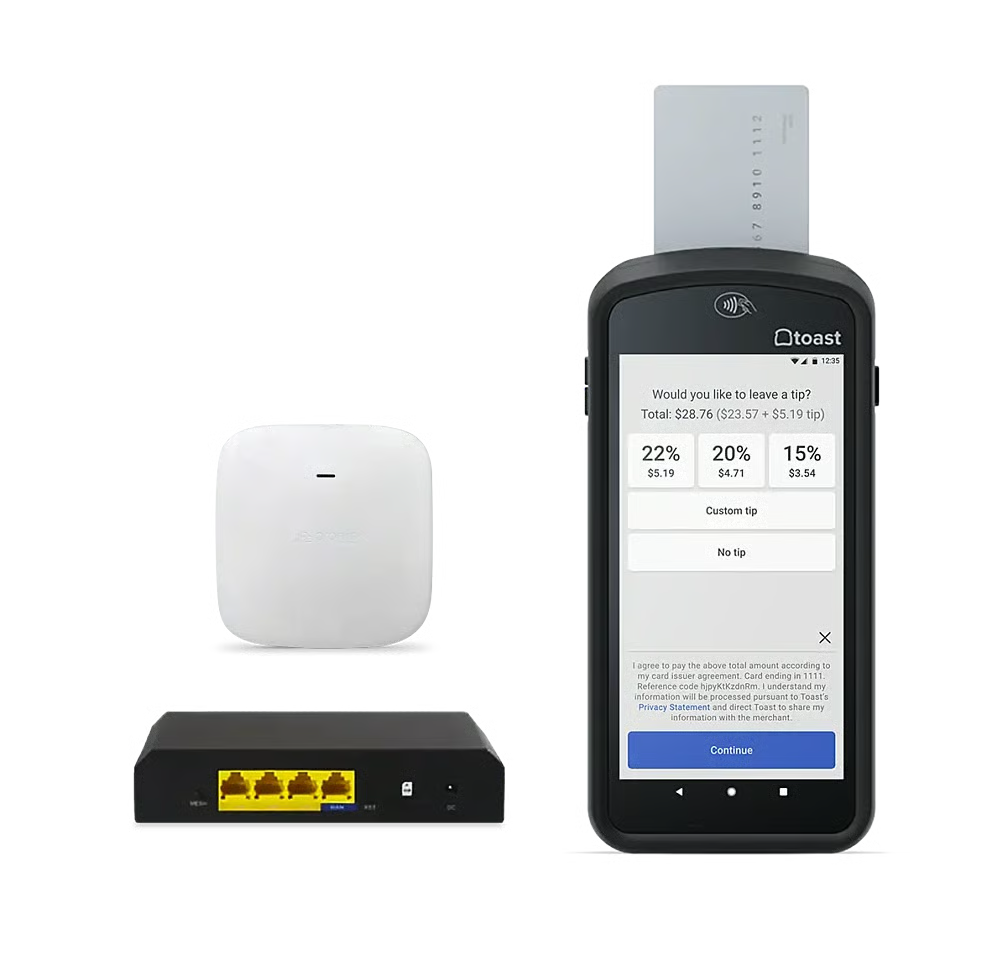 | 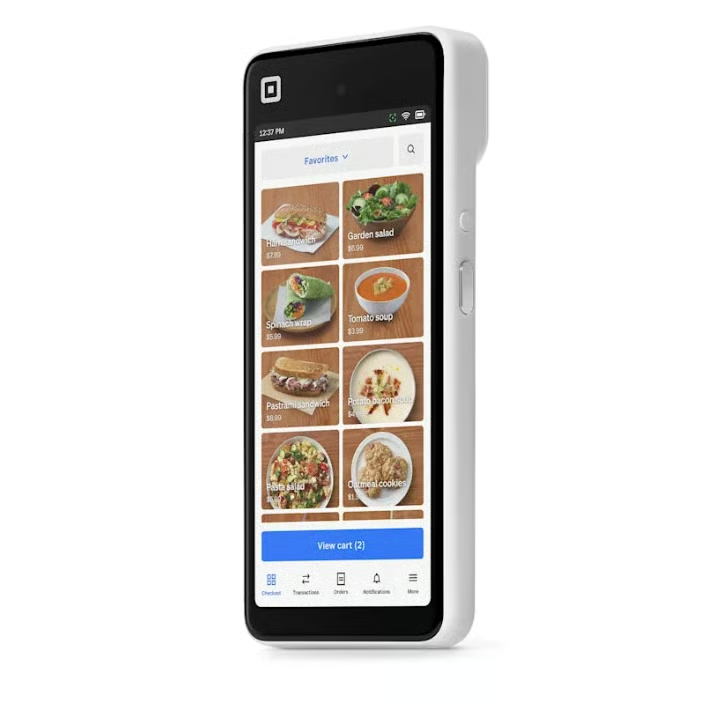 |
| Countertop terminal | 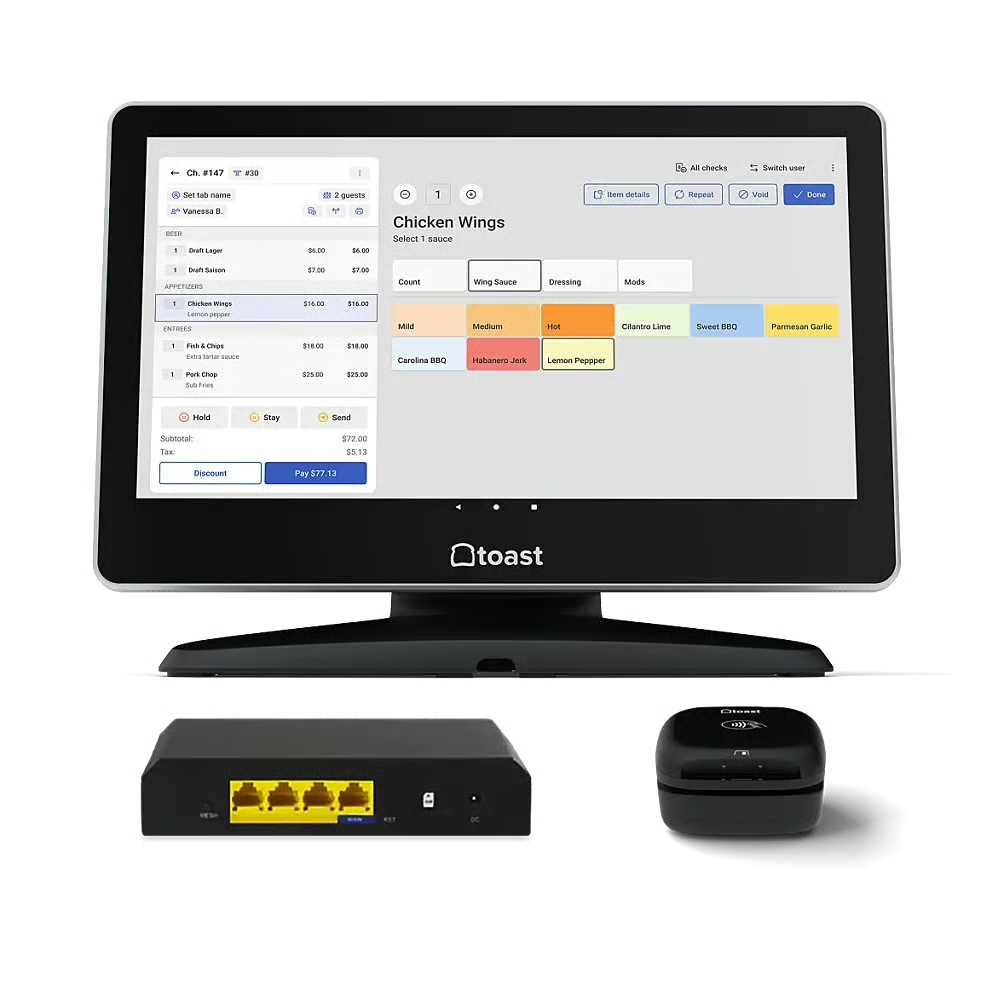 | 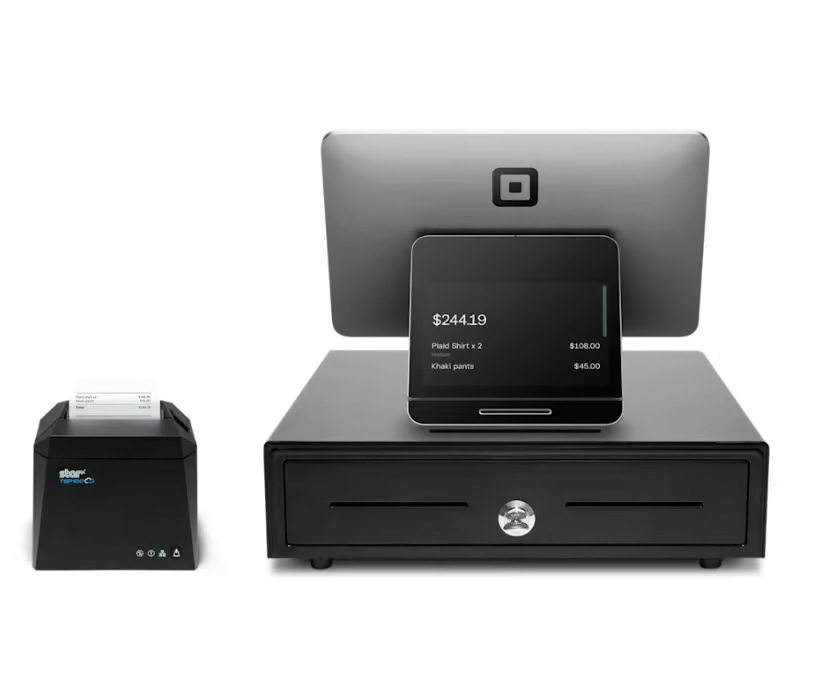 |
| Kitchen displays | 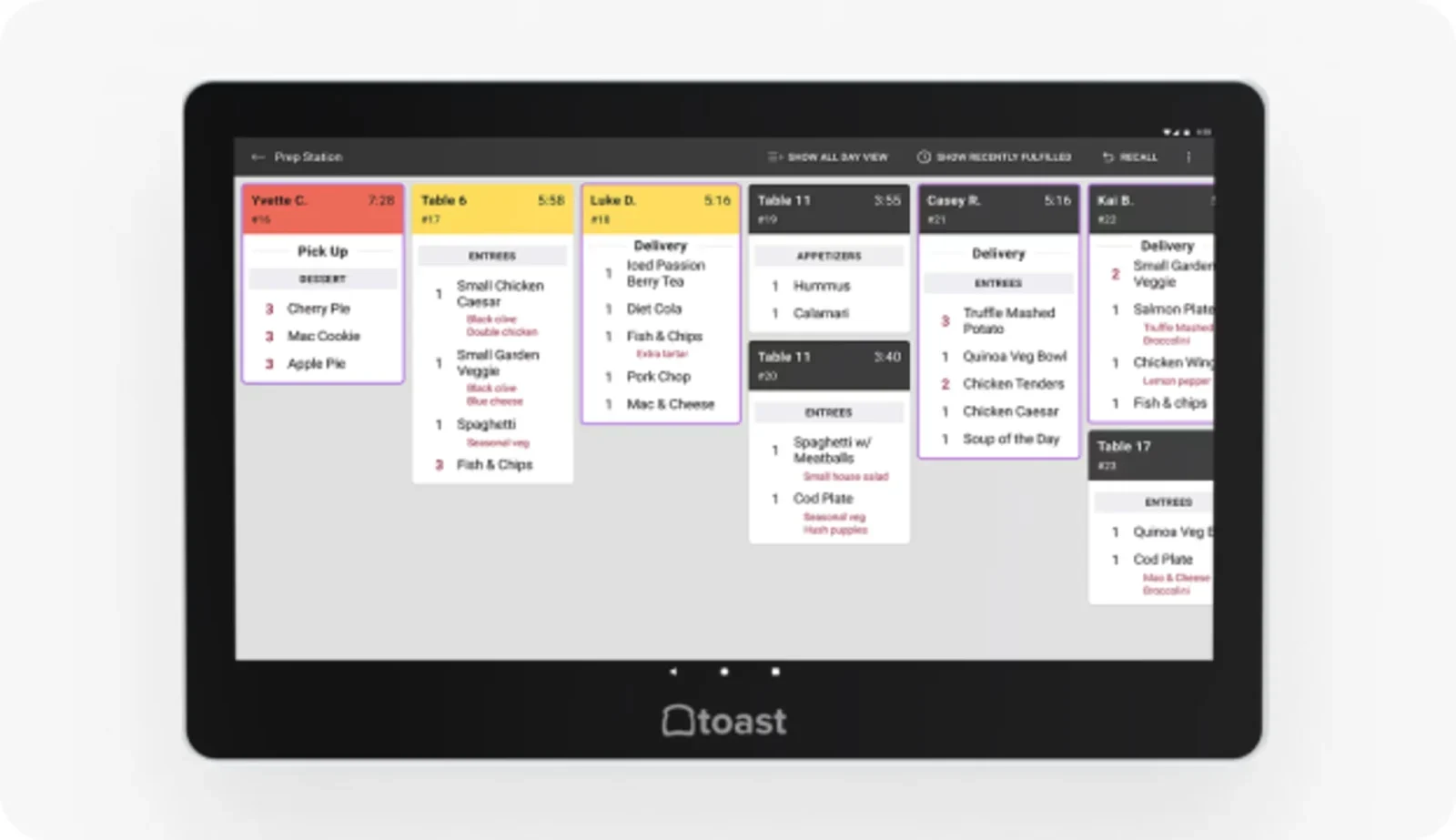 | 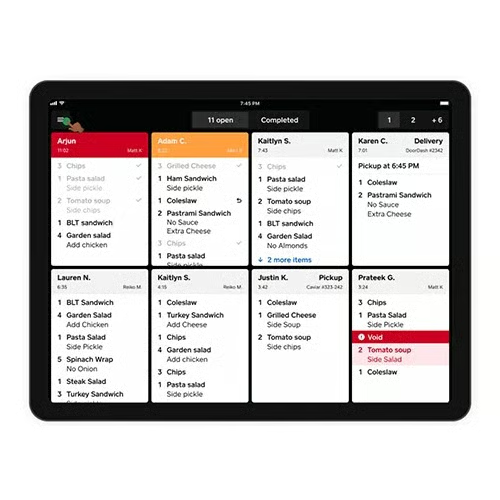 |
| Self-service kiosk | 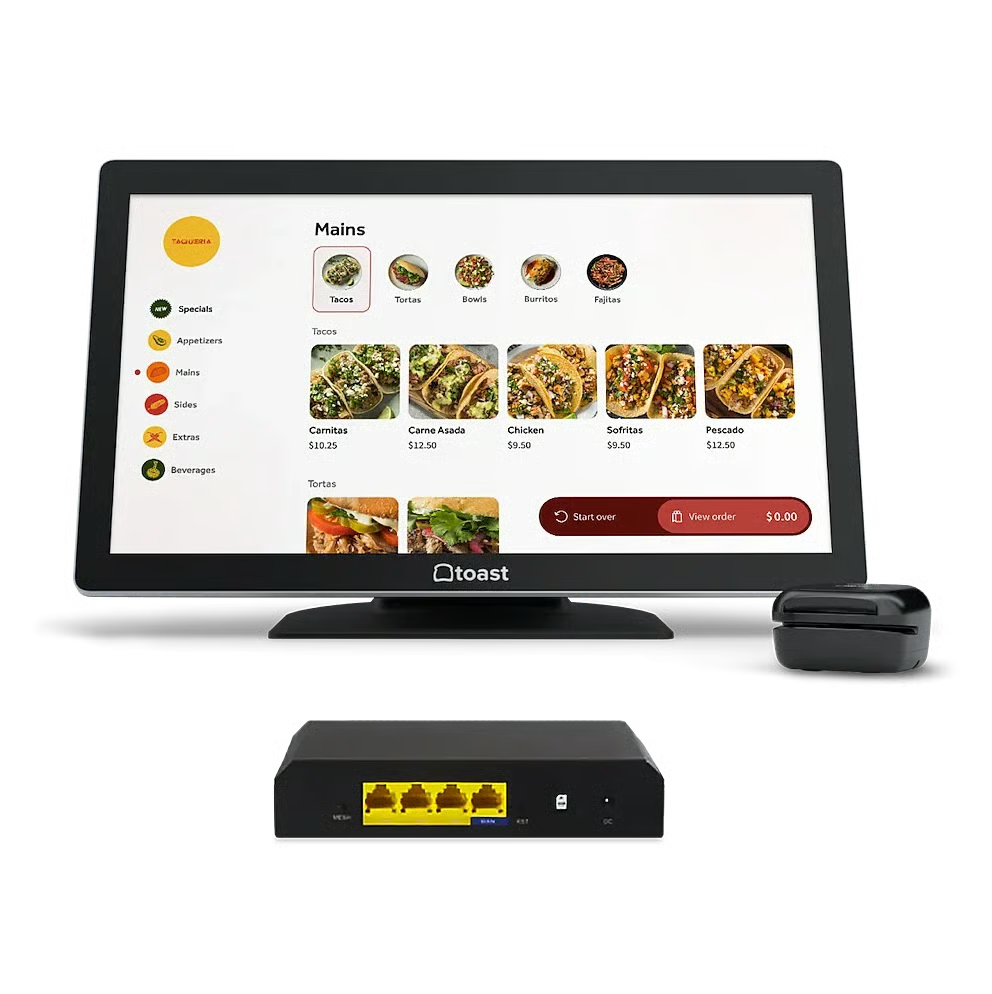 | 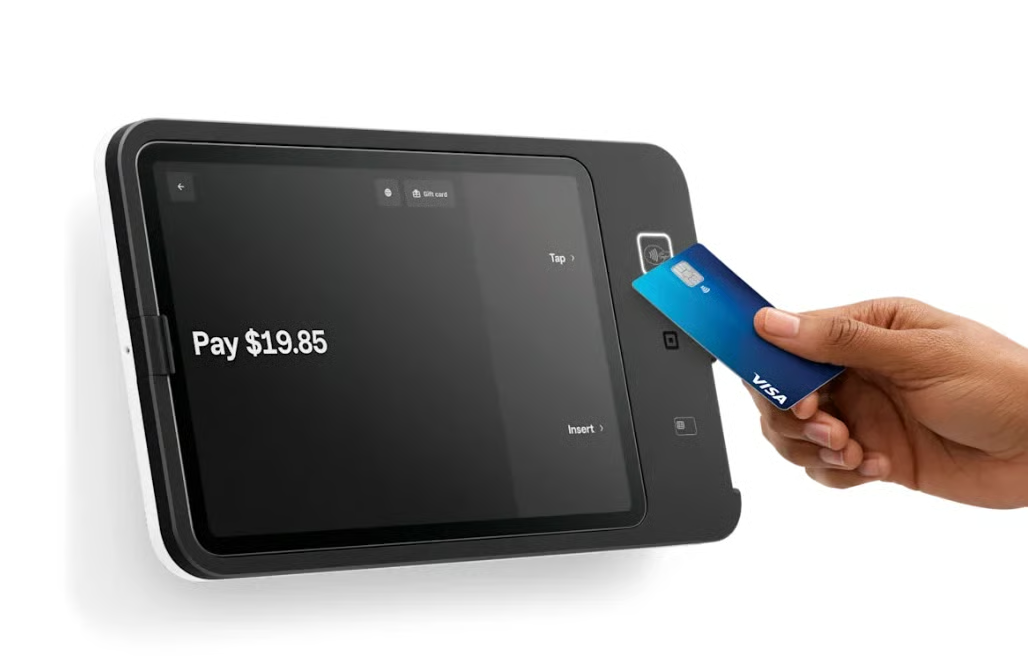 Square Kiosk (USB-C) — iPad not included($149 or $14/mo with financing) |
Square vs Toast: A true cost breakdown of monthly fees
Here’s a sample monthly breakdown of fees so that you can plan accordingly. I’ve outlined costs for both a small cafe with one terminal and a mid-sized full-service restaurant with three terminals. This way, you can see how software, hardware, processing, and add-ons add up, depending on the size of your operation.
For a small restaurant or cafe (single terminal)
| Category | Square | Toast |
|---|---|---|
| Monthly software | $0 (Free plan) | $0 (Starter Kit, pay-as-you-go) |
| Processing fees | ~2.6% + 15 cents | ~3.09% + 15 cents |
| Hardware | ~$900 (iPad + stand/printer) | ~$1,200 (Toast terminal) |
| Add-ons (optional) | Loyalty $45, Payroll $35+ | Loyalty $50+, Payroll $69+ |
| Estimated monthly | $0–$45 + processing fees | $0–$50 + higher fees |
Example: Calculating processing fees (small operator with $10,000 in monthly sales)*
Let’s assume a cafe processes $10,000 in card sales per month, with an average ticket size of $20 from around 500 transactions.
- Square Free (2.6% + 15 cents per transaction):
- Percentage fees = $10,000 × 2.6% = $260
- Per-transaction fees = 500 × $0.15 = $75
- Total monthly processing = $335
- Toast Starter Kit (3.09% + 15 cents per transaction):
- Percentage fees = $10,000 × 3.09% = $309
- Per-transaction fees = 500 × $0.15 = $75
- Total monthly processing = $384
At lower volumes, Toast’s Starter Kit ends up costing nearly $50 more per month in processing than Square Free, making Square the better option for cafes or food trucks running lean margins.
For mid-sized full-service restaurants (3 terminals)
| Category | Square | Toast |
|---|---|---|
| Monthly software | $49 (Square Plus, all terminals) | $207 ($69 × 3 terminals) |
| Processing fees | ~2.6% + 10 cents | ~2.49% + 15 cents |
| Hardware | ~$2,700 (3 iPads + stands/printers) | ~$3,000–$5,000 (3 terminals + KDS) |
| Add-ons (optional) | Loyalty $45, Payroll $35+ | Loyalty $50+, Payroll $69+ |
| Estimated monthly | $130–$200 + processing fees | $350–$500 + processing fees |
Example: Calculating processing fees (mid-sized operator with $30,000 in monthly sales)*
Let’s assume a restaurant processes $30,000 in card sales per month, with an average ticket size of $30 from around 1,000 transactions.
- Square Free (2.6% + 15 cents per transaction):
- Percentage fees = $30,000 × 2.6% = $780
- Per-transaction fees = 1,000 × $0.15 = $150
- Total monthly processing = $930
- Toast Starter Kit (3.09% + 15 cents per transaction):
- Percentage fees = $30,000 × 3.09% = $927
- Per-transaction fees = 1,000 × $0.15 = $150
- Total monthly processing = $1,077
At higher sales volumes, Toast’s Starter Kit processing fees climb much faster than Square Free, adding nearly $150 more in costs per month on $30,000 in sales.
*Disclaimer: These examples use the Square Free plan (2.6% + 15 cents) and Toast Starter Kit pay-as-you-go plan (3.09% + 15 cents). Actual rates may differ based on plan type, negotiated contracts, or custom pricing agreements.
How are Square for Restaurants and Toast different?
Restaurant-specific features
| Feature | Toast POS | Square POS |
|---|---|---|
| Restaurant operations | Yes (built-in: table mapping, coursing, KDS) | Yes (basic; advanced requires Plus Plan) |
| Payments & loyalty | Yes (integrated loyalty tools, advanced CRM) | Yes (loyalty is a paid add-on) |
| Inventory | Yes (recipe-level, ingredient tracking) | Yes (basic item-level) |
| Staff & payroll | Yes (scheduling, tip pooling, payroll built-in) | Yes (payroll via Gusto; limited scheduling) |
| Analytics | Yes (restaurant-specific, menu & labor insights) | Yes (basic sales reports only) |
- Restaurant operations: Toast offers a more advanced feature set, built for full-service dining with built-in tools like table mapping, coursing, and kitchen display systems that fully sync front- and back-of-house.
Square is simpler to set up and free to use. But it’s best for counter service since it lacks the advanced, built-in workflows needed for multi-course dining. - Payments & loyalty: Both process major cards, digital wallets, and gift cards. Toast has integrated loyalty tools that support tiered rewards and targeted offers, making it a stronger option for guest engagement.
Square’s loyalty program is a paid add-on, offering basic punch-card-style rewards, which works well for small operators but is less advanced than Toast’s built-in system. - Inventory: Toast provides restaurant-focused inventory with recipe-level tracking that ties ingredient usage directly to menu items, giving operators more control over food costs.
Square’s inventory tools are free and functional for small menus, but they lack the advanced precision that larger restaurants need. - Staff and payroll: Toast includes scheduling, tip pooling, and payroll as part of its system, giving restaurants a complete labor management solution.
Square relies on third-party integrations like Gusto for payroll, which can work for small teams but adds complexity and cost as staff size grows. - Analytics: Toast delivers more advanced, restaurant-specific reporting, including menu performance, labor-to-sales ratios, and detailed cost controls.
Square provides free, straightforward sales reports and real-time transaction data, which are useful for small businesses but fall short for multi-unit or high-volume restaurants that need deeper insights.
Ease of use and setup
Both Toast and Square are user-friendly POS systems, but their approaches differ. Square is easier to set up, often in less than a day, making it ideal for those who want to get started quickly without learning a complex system. Toast, on the other hand, requires more lead time due to its robust, restaurant-focused toolkit and customization options.
The tradeoff is support. Toast offers stronger assistance with 24/7 live help via phone, email, or chat, plus personal onboarding and advanced training through Toast University.
Square provides weekday phone support, 24/7 automated chat, and an online knowledge base, but lacks the same level of one-on-one training.
Emerging tech and integrations
Both Toast and Square are expanding into AI and emerging technology, but their offerings suit different types of restaurants.
Toast’s strengths lie in its advanced, restaurant-focused add-ons. Delivery integrations with apps like DoorDash, Uber Eats, and Grubhub are available through its Partner Connect marketplace, while unified order flows across dine-in, takeout, and delivery are supported by the Toast KDS.
Higher-tier add-ons like ToastIQ bring predictive inventory tools and AI-driven upselling, making Toast especially valuable for full-service or multi-location restaurants managing complex operations.
Square keeps things simpler, with delivery included through Square Online and basic inventory tracking available for free. More advanced features like predictive analytics, delivery integrations across multiple apps, and AI-powered marketing require third-party tools or paid add-ons. For cafes, food trucks, or small restaurants, Square’s low-cost approach often covers the essentials without overcomplicating the setup.
User reviews
What actual users say about Toast: User feedback highlights Toast’s strong restaurant-specific features, reliable hardware, and integrated ecosystem of tools. Many reviewers appreciate that it’s designed specifically for foodservice rather than retrofitted from retail.
- “It’s designed for restaurants, not just retail with food added on.” — G2 review
- “The hardware is reliable. It holds up in the heat and chaos of the kitchen.” — Capterra review
- “Having payroll, loyalty, and online ordering in one system saves us a lot of time.” — GetApp review
On the other hand, there are the common frustrations and complaints about the provider.
- Pricing and contracts: Many dislike the two-year contracts and note that costs rise quickly with add-ons. “The add-ons add up very quickly, making Toast more expensive than we expected,” says one G2 review.
- Customer support delays: Some users report inconsistent support response times, especially during peak hours.
- Complex setup: Smaller operators mention that the system can feel overwhelming to implement, especially with multiple terminals.
What actual users say about Square for Restaurants: User feedback consistently highlights Square’s ease of use, low upfront costs, and flexibility. Many appreciate that it’s fast to set up and simple enough for new staff to learn quickly.
- “Training new staff takes minutes, not hours.” — G2 review
- “We launched the system in a single day.” — Capterra review
- “The flexibility to add or remove services without penalties is a huge plus.” — GetApp review
On the other hand, here are the common frustrations and complaints about the provider:
- Limited restaurant-specific depth: Some users feel Square lacks the advanced tools needed for full-service dining. It’s “great for a small cafe, but not strong enough for a full-service dining room,” says a G2 review.
- Hardware durability: A few note that iPads and consumer-grade terminals don’t hold up well in hot or wet kitchens.
- Occasional glitches: Users report freezes or bugs, especially when internet connectivity is weak.
Advantages of Toast
- Restaurant-first design: Built specifically for food service, Toast offers advanced features like table mapping, coursing, and kitchen display systems, making it ideal for full-service dining.
- Durable hardware: Spill-proof handhelds and kitchen-grade terminals are designed to withstand high-volume, high-heat environments.
- Integrated ecosystem: Payroll, scheduling, loyalty, and delivery tools are available in one platform, reducing the need for third-party apps.
- 24/7 customer support: Round-the-clock phone, email, and in-app support ensures help is available during late hours and weekends.
Disadvantages of Toast
- Two-year contracts are common: Most plans require a long-term agreement, limiting flexibility for operators who may want to switch providers.
- Higher processing fees: Entry-level plans carry steeper transaction rates compared with Square, raising overall costs.
- Add-on costs: Many valuable features (loyalty, payroll, online ordering) come at extra monthly fees.
- More complex setup: Installation and training take longer compared with Square’s plug-and-play approach.
Advantages of Square for Restaurants
- Low-cost entry: Free plan available with core POS features; no upfront contract required.
- Simple setup: Plug-and-play installation lets restaurants, cafes, or food trucks start running quickly.
- Flexible hardware options: Works with iPads, Square Register, and new handheld terminals, allowing operators to choose budget-friendly devices.
- Month-to-month terms: No long-term commitments; restaurants can scale or switch easily.
Disadvantages of Square for Restaurants
- Limited restaurant features: Lacks advanced workflows like coursing and table management, making it less suitable for fine dining.
- Reliance on add-ons: Payroll, loyalty, and advanced inventory management require paid integrations, adding cost and complexity.
- Support not 24/7: Phone and chat help are available during business hours only, which may be restrictive for late-night operators.
- Less durable hardware: Consumer-grade tablets may not withstand spills or heavy kitchen use.
Frequently asked questions (FAQs)
Is Toast the same as Square?
No. Toast is a restaurant-specific POS system with features like table management, kitchen displays, and payroll tools. Square is a more general POS that serves many industries and is popular with small cafes, food trucks, and quick-service restaurants.
What is the disadvantage of Toast?
The main disadvantages are higher processing fees on entry plans, two-year contracts, and additional charges for key features such as loyalty programs or payroll. These costs can add up quickly for smaller restaurants.
Who is Toast’s biggest competitor?
Square for Restaurants is Toast’s largest direct competitor, but other rivals include Lightspeed, Clover, and TouchBistro. Square is often chosen by small operators, while Toast is preferred by full-service and multi-location restaurants.
How much does Toast cost compared to Square?
Toast starts at $0 per month on its pay-as-you-go plan but has higher processing fees and most features as paid add-ons. Square offers a free POS plan with core features and flat-rate processing at 2.6% + 15 cents. For most small operators, Square is cheaper overall.
Which is better for a small restaurant, Toast or Square?
Square is usually better for small cafes and food trucks because it has no contract, lower fees, and quick setup. Toast is a stronger choice for full-service restaurants that need advanced tools like coursing, kitchen displays, and payroll.
Last bite
In the Square vs Toast matchup, your ideal choice depends on your restaurant’s scale and priorities. Square excels for small cafes, food trucks, and new operators who want quick setup, low upfront cost, and enough core functionality to get started without being overwhelmed. Its free plan, predictable flat-rate processing, and flexibility make it attractive for budget-conscious or simple operations.
On the flip side, Toast offers the more complete, restaurant-tailored solution. Its built-in tools for table management, inventory, staff, analytics, loyalty, and kitchen workflows outshine Square’s add-on approach, especially in full-service and multi-location environments. Toast costs more, has a learning curve, and often requires longer implementation, but for restaurants dealing with complexity and volume, it pays off.So, bottom line — choose Square when you want simplicity, affordability, and speed. Choose Toast when you need a robust, all-in-one system that’s built specifically for the demands of a full-service or multi-unit restaurant.
