


Search engine optimization (SEO) is one of the most important aspects of discoverability for your restaurant in 2026. This is because most new customers will find you through Google Search and Maps, Apple Maps, review sites, “Near Me” searches, and even AI search tools. The reality for most restaurant businesses is that you can create delicious food and have an incredible dining experience, but still lose out if your SEO is not optimized for new customers.
SEO is not just a tool for large restaurant groups; it can be a key driver of business for independent restaurants, especially as search engines prioritize local businesses for relevance. Restaurant SEO is the specific process of making it easy for customers to find your business, assess your offerings, and determine whether your restaurant is the right fit for them.
Let’s discuss what restaurant SEO is, how it works, and what you can do to improve your search discoverability.
What is restaurant SEO?
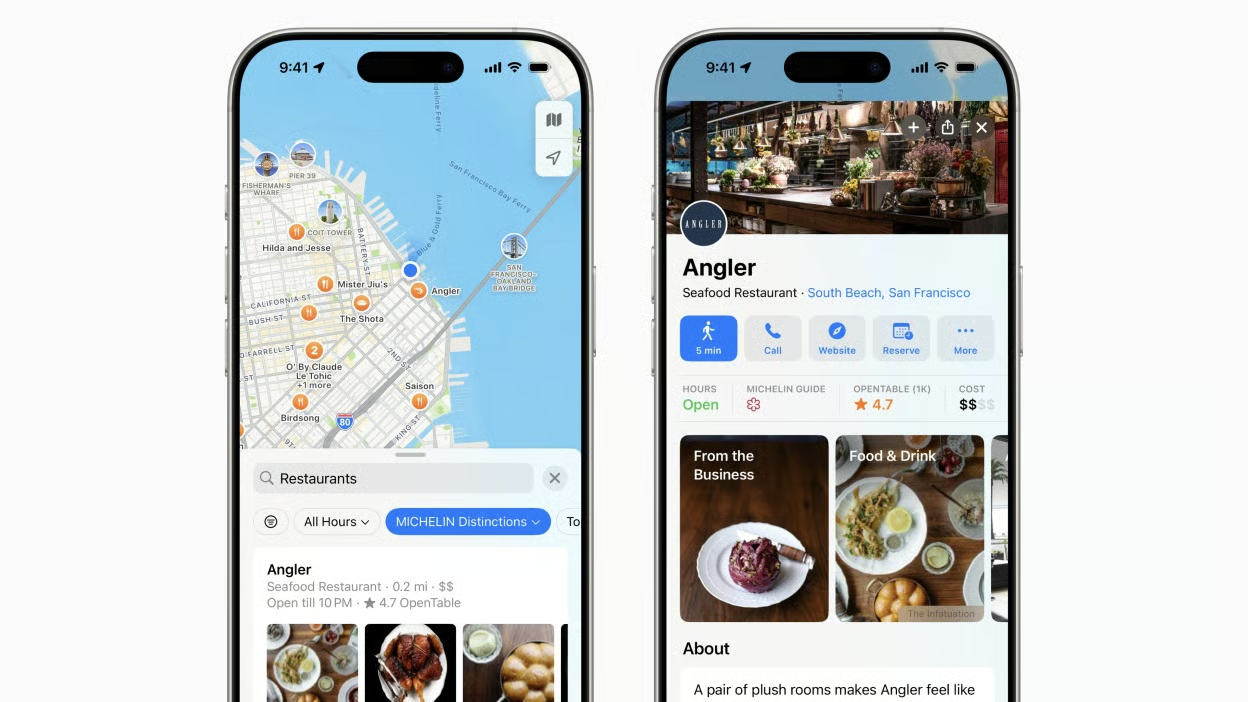
SEO for restaurants is the process of optimizing your online presence so that people can discover your restaurant when searching for places to eat or drink. Some examples of where customers may find your restaurant online include:
- Google Maps
- Apple Maps
- Google Search
- AI search (ChatGPT, Gemini, Claude)
- Voice search
- Social media tags
It is important to note that traditional SEO enables your page to rank in a general Google search for restaurants. Restaurant SEO goes deeper, also helping your restaurant appear on maps and in other local search results. Restaurant SEO requires both traditional Google Search rankings and in-depth map placement across various online platforms for your placement.
How AI search is changing SEO for restaurants
With AI search, users can ask complex, targeted questions rather than perform a quick keyword search. Traditional search engines rank and display websites based on SEO, whereas AI search synthesizes an answer in real time based on a variety of factors. AI search will pull data from restaurant websites, Google Business Profiles, review sites, and online ordering apps simultaneously to determine search results. This is why having your restaurant SEO up to date is so important, as clear, concise facts about your business are easier to synthesize in an AI search.
While Google Search still dominates in 2026, with an estimated 86% of searches conducted through the engine, searches via AI tools are projected to already be at 3.2%. What gets interesting is that 37% of consumers now start with AI, but 85% still verify through traditional search. This means AI adoption is growing, and soon the trustworthiness of finding a restaurant through AI will be as well. Restaurant SEO is vital to AI search, so having yours optimized consistently is integral as we move more towards AI adoption by consumers.
How restaurant SEO works
To understand how SEO marketing for restaurants works, we first need to understand what search engines are actually doing with this data. Search engines will gather information from a restaurant’s website, Google Business Profile, local publications, review platforms, and even social media. Once this data is compiled, the search engine will use it to determine what the restaurant offers, where it is located, and whether it is useful to the user searching. Below are the three key pillars a search engine uses when deciding to show your restaurant.
Relevance
Relevance determines how closely your restaurant matches the diner's request. This involves Google recognizing the exact kind of business your restaurant is. Are you a cafe, restaurant, bar, or takeout-only concept? Do you serve breakfast or happy hours, or offer 24/7 service? Being direct in your category selection on your Google Business Profile and clearly explaining your concept type and operating availability are highly important for SEO relevance.
Keywords also play a big role in how search engines determine the relevance of your page. For example, “pizzeria in Houston, Texas” will flag that both your restaurant is a pizzeria and that it is located in the Houston area. Keywords such as these will be relevant to those searching for your restaurant in a given region. This is why keywords are so valuable for SEO, as they are what search engines use to determine relevance.
Distance
Distance measures how close the user conducting the search is to the actual place of business. This part of the search engine is likely the least under your control, aside from ensuring your address is accurate and appears correctly online. Distance will determine how SEO ranks restaurants, as locality is just as important to users as relevancy. Ensuring your business address and location are updated accurately online is critical to performing well in search engines.
Reputation
Reputation is explained by Google to be the general prominence with which a business is known. It is this “prominence” that will determine if your restaurant is worth recommending by the search engine. This is often concluded by the following:
- Number of online reviews
- Quality of online reviews
- Links from credible websites
- Local publication coverage
- General consumer interest
- Any awards or accolades awarded to your restaurant
While reviews are important to your business, they are just a piece of the SEO puzzle. Take advantage of local recognition, awards such as James Beard, Eater, or Michelin, and any other positive attribution to your restaurant. Positive sentiment in your online reputation goes a long way toward determining how you show up in search results
Strategies for search engine optimization for restaurants
Start with your Google Business Profile
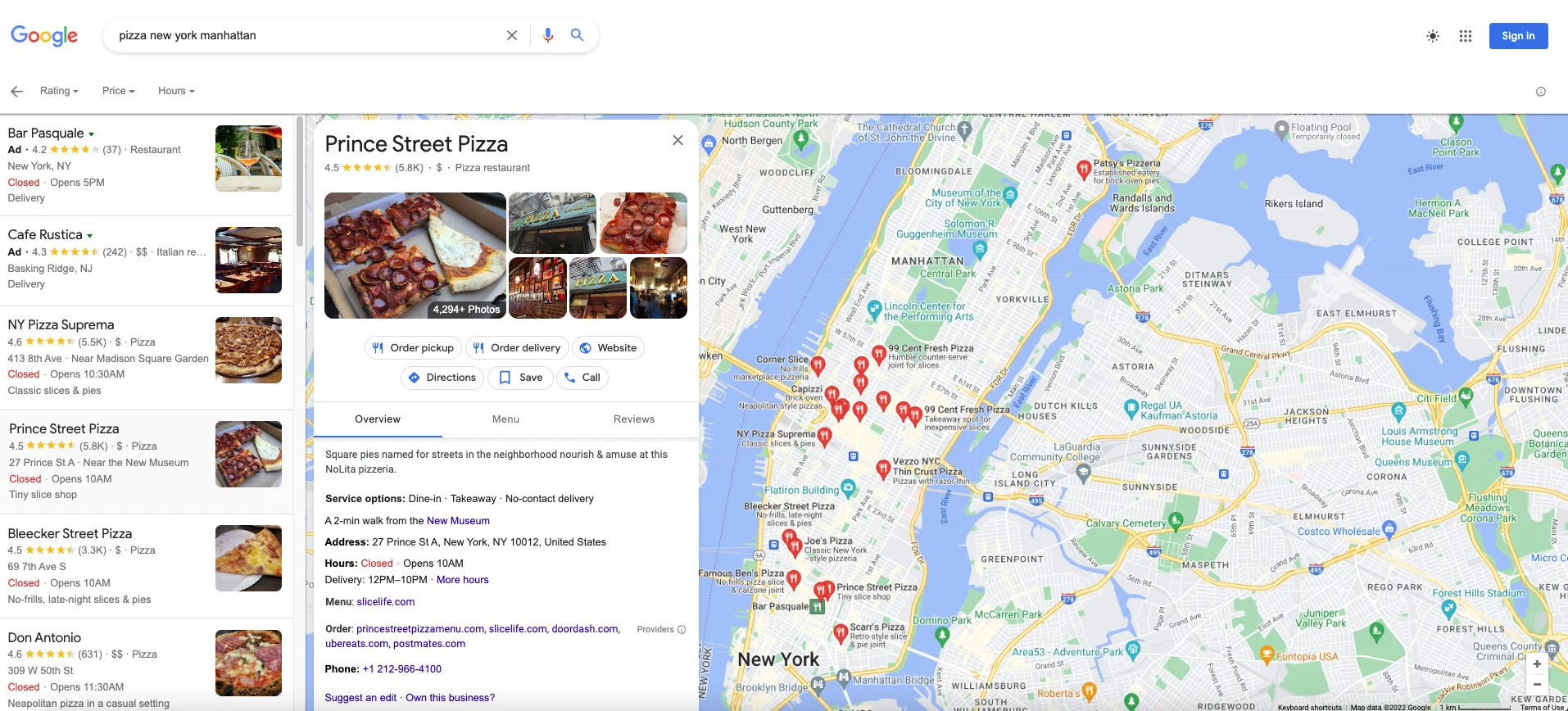
Your Google Business Profile is the essential foundation for being discovered in search and other online rankings. This profile controls much of the information visible in both Google search and Google Maps, and it is important that it remain accurate. The nice part about Google Business Profile is that Google allows restaurants to claim and manage their profiles at no charge, making it an effective yet inexpensive way to get your restaurant noticed. Below are the recommended steps for claiming and managing your Google Business Profile.
Step 1: Claim your profile
For starters, search for your restaurant to ensure no other listings for the same location or name exist. Once you confirm this, you can claim ownership through Google and grant access to the appropriate users who need it to manage or update the account. I highly recommend always retaining access to your Google Business Profile account and never letting any outside agency or SEO-focused contractor take ownership of it.
Owning your profile gives you full control over your business on Google and elsewhere, which is vital for discoverability in 2026. Leaving this in the hands of others is not only reckless but also extremely risky for the success of your business when it comes to SEO. Also, if a contractor leaves the job or no longer works with you, losing access to this vital profile could be lost, which is an even bigger headache to get back.
Step 2: Select accurate categories
Choosing the most specific category for your core business is important to SEO accuracy and customer awareness. I suggest adding only relevant second categories when they constitute a substantial core part of the business. Some examples of categories include Italian restaurants, pizza restaurants, cocktail bars, and breakfast restaurants. Avoid adding categories based on attractive keywords; instead, choose those that honestly reflect your business.
Step 3: Write the business description
Your Google Business Profile will require a business description that includes: cuisine, dining style, specific neighborhood or region, signature offering, a meaningful differentiator, and any other major services offered. Avoid any “best” restaurant claims and outdated or seasonally based promotional descriptors.
Step 4: Add (and maintain) hours and special hours, and fill out contact information
It is important that your hours are up to date and that any special hours around holidays or other events are in the Profile. Furthermore, the contact information, such as the phone number and address, also needs to be added and accurate. Ensuring your hours and contact information are accurate is one of the most important aspects of your Google Business Profile.
Step 5: Add reservation, website, and ordering links
Your Google Business Profile will include links to reservation pages, your website, and, if available, online ordering pages. These links need to consistently work and guide your customers through engaging with your business.
Step 6: Upload menu and photos
Google allows you to build out a menu in your profile, making it easy to read and scannable for SEO purposes. I suggest adding your menu to Google, rather than just uploading a photo of it, as you will yield better SEO results. Uploading your menu into Google allows the search engine to better identify keywords and offerings, which then adds to the relevancy of your restaurant to any given search. Images of your food can also be uploaded to your Google Profile, so choose high-quality images of your dishes to make your offerings more appealing to potential customers.
Step 7: Complete attributes and accessibility information
This last piece is a sneaky-good way to market the intangibles your business offers — details on WiFi, dine-in and takeout service, delivery, outdoor seating, and payment and reservation options. You can also share accessibility information for customers. I also suggest ensuring messaging is turned on and monitored, as this is a good way to answer questions and address any feedback.
Reviewing your profile monthly is critical to ensuring that all the inputs we have discussed remain accurate and accessible to your customers when they view your profile.
Build a restaurant website Google can understand
The website for your restaurant needs to be easy for both your customers and Google to understand. It should have simple navigation through sections for ordering, reservations, menu, locations, private events, and online ordering. The website should load quickly for customers and be hosted over HTTPS. The text on the website should be readable, and menus should be in HTML format, not PDF. Finally, your website should maintain consistent branding, naming conventions, contact information, and operating hours.
Your website buildout needs to be readable by search engines, and the more work you put into optimizing it, the better. The website for your restaurant is the one true platform you control for your business. Optimizing for greater customer awareness is an investment that pays dividends in restaurant SEO.
Below are some of the common mistakes I suggest you avoid when it comes to building a restaurant website:
- Oversized images
- Video-heavy homepages
- Difficult animations
- Pop-ups covering the menus
- Broken booking or reservation widgets
- Important information hidden on mobile due to poor formatting
- Slow loading times
Learn more in our in-depth guide to creating a restaurant website.
Find the right restaurant keywords
Keywords are the building blocks of success in SEO. Knowing the right keywords begins with understanding potential customers’ search intent. The right combination of keywords, much like ingredients in a recipe, will yield tremendous results for your restaurant SEO needs. Below are some keyword combination examples to help you choose the best restaurant keywords for you:
- Cuisine + location: “Indian restaurant in Toronto”
- Meal time period: “Brunch near me”
- Dish type + location: “Best sushi downtown”
- Occasion: “Romantic restaurant in Austin”
- Service: “Tasting menu in Chicago”
- Attribute: “Dog-friendly cafe”
- Dietary need: “Peanut allergen-friendly pizzerias”
As you can see, keywords are built on customers' intentional searches within a specific area or region. When you identify the right ones, it opens your business up to highly targeted SEO results. You can find keywords to be used on your website in the following tools:
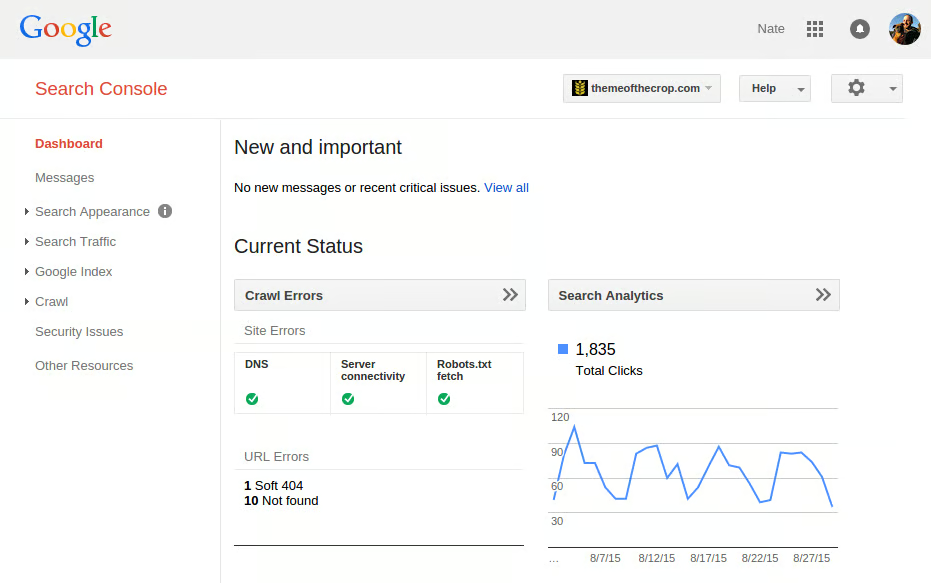
- Google Search Console
- Google autocomplete
- “People also ask” in search queries
- Competitor pages
- Customer reviews
- Local events and seasonal demands
Finding the right keywords comes from understanding your business offering and the ability to tie your website's location and services to SEO results.
Optimize every important page
Every page on your restaurant’s website plays a part in bettering your restaurant SEO results. This means that every page needs to be optimized and scannable by search engines online. Below are the pages you will likely have on your restaurant’s website and how to optimize for each of them:
- Homepage: State the cuisine, location, and main value proposition of your restaurant. Ensure links to menus, ordering, and reservations are prominent and easy to access.
- About: Your About page should cover your staff’s story, the restaurant's origins, and your approach to foodservice. It should also cover any unique sourcing your restaurant uses for ingredients and the community connections it has made to serve its guests.
- Menu: Your menu page should offer details about your dishes, pricing, service types, and dietary information. This section should be in HTML format.
- Location: Your location page needs to focus on your operating hours, address, phone number, location on the local map, parking, menu, and location-specific photos, especially if you have multiple units.
- Reservations: Your reservation page should include booking links, your walk-in policy, large-party rules, cancellation policy, and phone number.
- Private Events: Private event pages need to include your event capacity, event types, sample menus, and photos of the location or services.
- Careers: On this page, explain the workplace, benefits, locations, open roles, and a link for specific job applications.
Optimize your menu for search
Optimizing your menu for search is a delicate balance of naming your menu items to fit your brand and ensuring they stand a chance of showing up in search engines. I would say the menu is the most important searchable asset for restaurants, as it lists the main items someone would buy when choosing to visit your business. Your menu should be published as a readable webpage and include engaging titles and descriptions for the food you are serving.
For example, instead of saying “Cheeseburger”, I would suggest saying “House Cheeseburger with secret sauce, pickles, onion, and fresh-cut French fries.” The title and descriptor you use to name dishes on the menu allow search engines to scan and pick up these items, which are then shown to a potential customer. Below are some of the different aspects of a restaurant menu that will perform in restaurant SEO:
- Signature dishes
- Regional and cuisine-focused dishes
- Seasonal menus
- Brunch menus
- Happy hour menus
- Cocktail menus
- Kids’ menus
- Vegan and vegetarian options
- Gluten-free options
- Halal or kosher offerings
Keeping your menus consistent is the last point to note when it comes to ranking better in Google Search. Your menus should match across your website, Google Business Profile, third-party sites, and wherever else your customers can find your restaurant’s menu.
Earn more reviews (without breaking Google's rules)
As we discussed earlier, your restaurant's reputation matters for ranking higher in restaurant SEO. Earning more reviews from your customers is an important task that many restaurant operators overlook. I believe this is because asking for feedback can be an uncomfortable experience, but it shouldn’t be. For starters, be sure to understand where feedback will come from. The major platforms to expect customer reviews are:
- Apple
- TripAdvisor
- Yelp
- OpenTable
- Resy
- Third-party delivery apps
These sites all collect customer reviews, so it is important to monitor them consistently to address negative feedback and learn what is actually working from positive feedback. When it comes to asking for feedback, I personally recommend a post-visit email or a QR code on the receipt or to-go packaging. I would also always ask for feedback, and not just simply five-star reviews. You want honest reviews from all of your customers.
When it comes to what not to do with customer reviews, I would avoid paying for reviews or offering food or other perks in exchange for one. I would also avoid asking employees or relatives, as you need to build your reputation with every new customer who walks through the door. Finally, do not buy fake reviews, as this will harm your restaurant’s SEO. Honest reviews from your customers help you tighten your operations and improve your business overall.
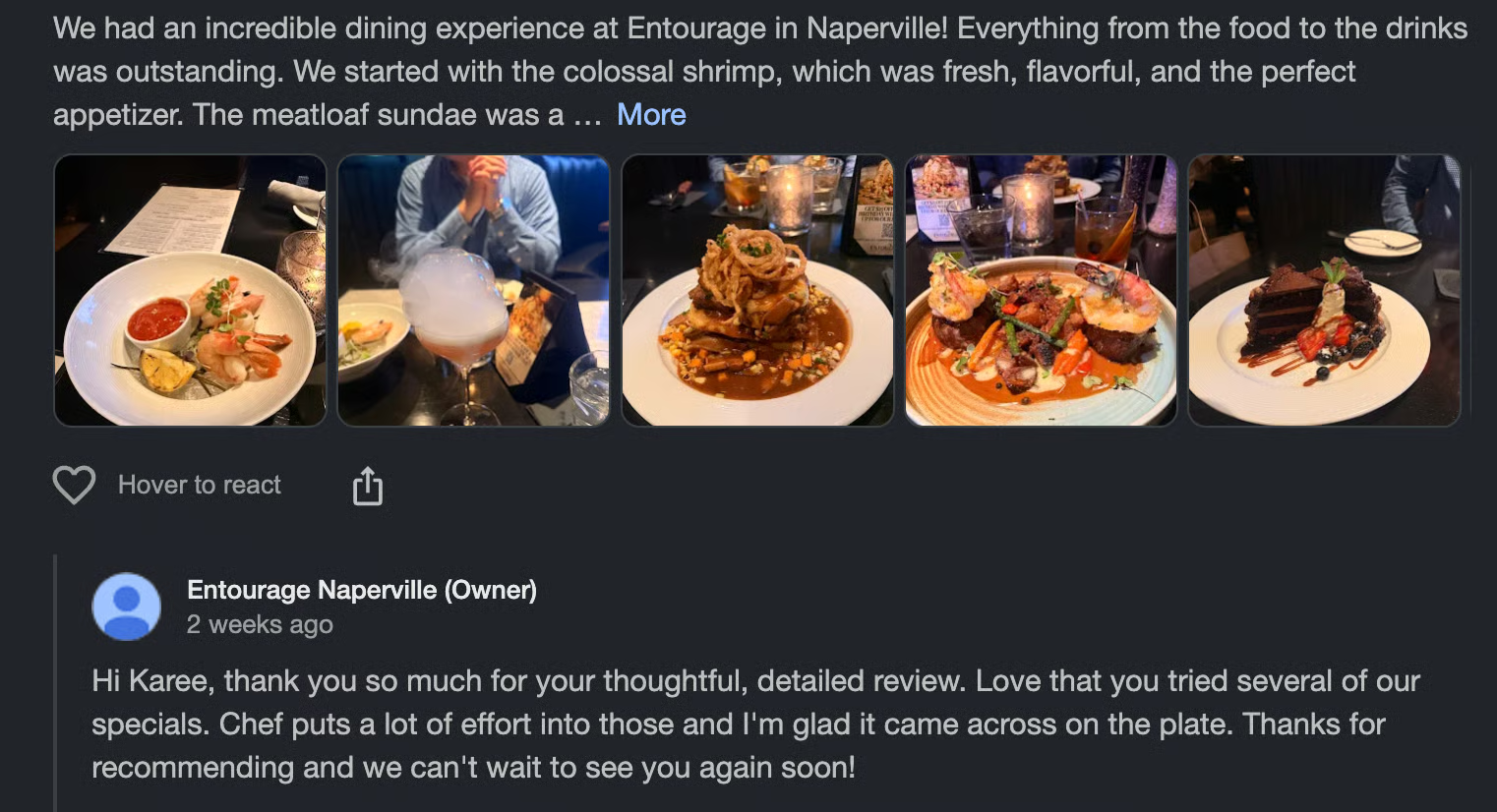
When responding to negative reviews, always acknowledge the concern and flag the core issue the guest is raising. I would always move the conversation offline and never be defensive when critiquing food or service. I would also suggest thanking those who leave positive reviews, as it shows your business cares and that your customers will be heard by management. Managing reviews helps improve your business and lets you see what your customers think is working and what isn't.
Find the basics in our basic guide to restaurant reputation management.
Improve your local SEO
Local SEO for restaurants will ensure your food business is seen by customers in your area. Improving your local SEO is a constant battle to ensure your website is up to date and relevant so search engines pick it up. For starters, you always need to be consistent with NAP (name, address, phone number). This means that on every site where your business is represented, your restaurant’s name, address, and phone number must match. This may seem simple, but this mismatch is more common than you think and leads to restaurants underperforming in SEO.
To ensure NAP consistency, use this monthly checklist, where applicable, to check that your NAP information is correct across all sites:
I would also prioritize reputable local listings, such as the chamber of commerce, the tourism board, downtown or city associations, local restaurant associations, neighborhood business groups, and hotel dining guides. Getting exposure in these local listings can do wonders for your local SEO performance.
Finally, you should aim to build links by being mentioned in other posts or websites. This can be through local media coverage, restaurant weeks, food festivals, and charity dinners. I have also seen restaurants find success through event sponsorships, local restaurant collaborations, hotel or wedding catering, and community partnerships. The more your restaurant shows up in local media outlets, the better.
Use structured data (without becoming an SEO expert)
When it comes to using structured data for your restaurant SEO, it simply means using data in a format search engines can identify. The Restaurant schema is a specific type of the LocalBusiness schema. A schema is code added to a website to describe its content in a standardized format. Think of it as giving the search engine explicit facts rather than having the engine scan and interpret data. Restaurant owners can create a schema through a plugin, with a testing tool to verify availability with Google’s Rich Results Test.
The LocalBusiness schema is a broad schema type for organizations that serve customers from a physical location and is used to describe such businesses. Restaurant schema dives further and helps search engines identify the following:
- Name
- Address
- Phone number
- Operating hours
- Menu
- Cuisine type
- Price range
- Images
- Reservations
- Service type
- Geographic details
It is important to note that if you are operating more than one location, you should use a separate schema entry for each location. You also need to ensure the code matches the information that is visible on the page. I recommend validating the schema using Google’s Rich Results Test. By working on this, the schema helps a search engine understand the restaurant better. This does not mean better results; rather, it means easier understanding, so your information still needs to be accurate and SEO-optimized.
To perform the test, all you need to do is to simply go to the website, enter your restaurant’s webpage URL, and click Test Code or Test URL. Google will then flag any structural errors, with red flagging true errors and yellow flagging issues they recommend fixing. You should then make changes to your schema until these errors no longer appear and request indexing from the tool for later use.
Measure your SEO performance
After creating your restaurant's SEO plan, optimizing your website, and ensuring all your information is accurate, the next step is to monitor performance. There are a variety of ways you can go about seeing how effective your SEO is for your restaurant, but the common ways to track are:
- Google Business Profile Visibility
- Website traffic from organic search
- Phone call volumes
- Reservation data
- Menu clicks
- Online order volume
- Private event/catering inquiries
- Gift card sales
- Keyword visibility
To track all of this, some tools you can use are:
- Google Business Profile performance
- Google Analytics
- Google Search Console
- Reservation and third-party ordering platform results
- Website host analytics
- UTM-tagged links
When monitoring, you first want to determine whether more or fewer people are learning about your restaurant over a given period. You will also want to track which information customers are viewing on your website, such as your menu or hours, and where you need to improve to increase awareness. You will also want to track whether customers are taking action and, if not, why. Finally, following the actions taken to determine whether revenue is being generated is critical to tracking the success of your SEO efforts.
Common restaurant SEO mistakes
While this guide can make SEO seem simple, there are quite a few common mistakes many operators make when optimizing their restaurant SEO. Below are some of the more common examples of mistakes I have seen that hinder SEO results:
- Publishing PDF-only menus: This hurts SEO because they are difficult to read on mobile, are not always scannable, and make it hard to find important dishes and dietary information in your menu. Publishing your menu in HTML format or having a dedicated page on your site is much better than a PDF version.
- Ignoring customer reviews: You do so at your own risk. Customer reviews not only provide key insights into gaps in your business offering but also affect your reputation in search results. Actively monitoring and engaging in reviews by offering a resolution or simply acknowledging the issue has been heard is critical for your restaurant’s SEO reputation.
- Not updating your business hours: This can hurt both your SEO performance and prospective customers who are trying to visit your business. If your hours are not up to date, customers may feel they have wasted their time and may not give your business a second chance. This, in turn, reduces trust with your customers. This is especially prevalent during holiday seasons, so being diligent is recommended.
- Failing to use local language: A restaurant’s website will often have great layouts, intuitive menu design, and other key aspects that drive intrigue, but then forget to call out the area in which they are located. Remember, SEO relies heavily on your location when suggesting your business to customers, so having your city or neighborhood within your website in various locations is a must.
- Operating without a website: Not having one simply limits your visibility in search engines. This is because your information depends entirely on platforms you have no control over, such as Google Maps or AI search. Furthermore, these platforms have very little information to search, making it that much less likely that your business will show up in search results.
- Broken reservation and ordering links: Inaccessible reservation and ordering links are another major issue that deters customers from using your website and visiting your restaurant. You need to be consistently testing your conversion links. If they are not working, you are losing customers at the highest point of intent to try your restaurant.
- Duplicate listings: If you have duplicate listings of your business online, they need to be consolidated. This essentially splits customer traffic, reviews, and other information SEO algorithms use to highlight your restaurant.
- Excessive stock photography: If there were an investment I would encourage operators to make, it would be in true food photography, even if that means spending time doing it yourself in your restaurant. Stock photos do not accurately represent your restaurant’s space or food and can deter customers on that basis alone.
Frequently asked questions
Restaurant SEO can be confusing and definitely requires a focused, detail-oriented approach when trying to optimize your business’s discoverability. That said, below are the most common questions I am asked about restaurant SEO.
How long does restaurant SEO take?
Basic updates to your Google Business Profile can have an immediate impact on your search engine discoverability. That said, it generally takes several months to see the full impact of SEO on your business. Timing will depend on your market and how often you update and maintain SEO for your site.
Do restaurants need blogs?
The short answer is no: restaurants do not need blogs, especially just to say they have one. I would prioritize website assets such as reservations, location, menus, and catering options before having a section optimized with a blog. If your restaurant has generally unique or informative knowledge to share, then a blog can be a nice-to-have.
Should I hire an SEO agency?
A single-location independent restaurant generally does not require an agency, as all updates and optimization opportunities can be handled by ownership. An agency or specialist can be used for site migration, multi-location SEO, super competitive food markets, and large content programs. Avoid anyone who guarantees top Google rankings or claims to be able to pay Google to rank your restaurant higher.
How much does restaurant SEO cost?
The beauty of restaurant SEO is that many tasks can be done for free by you or your on-site staff. I recommend focusing on the basics of your Google Business Profile and website optimization before sinking costs elsewhere. Having the basics down is critical in SEO, much like it is in cooking.
Does social media improve SEO?
Social media can indirectly improve SEO by awareness, online chatter, and other customer highlights. Social media accounts will also rank in search engines and can help get your brand in front of potential customers.
Can I rank without a website?
Yes, a restaurant can rank and show up in Google Maps with just a Google Business Profile. However, achieving a full presence across all online searches is quite difficult without a website that showcases your business and its many details. While a website is not technically encouraged, it is highly recommended.
How often should I update my SEO?
You should update your SEO whenever any core part of your business changes. You should also review operating hours, menus, and links monthly. I personally recommend monthly analysis, but some restaurants do prefer quarterly tasks as well. Conducting audits before busy seasons, holidays, and new menu or product launches is highly recommended.
Last bite
There is no one great hack to doing better at SEO. Much like practicing your knife skills, SEO compounds over time with consistent focus and persistence. It is the ongoing work of ensuring your online information about your restaurant is accurate, clearly understandable, and efficiently conveys what your restaurant offers. You should aim to make your information about your restaurant consistently easy for any customer to understand. With this goal in mind, you will perform far better with restaurant SEO.
